Amsterdam Amstelpark Orangerie
Zone2Source Residency
August/September 2021
A Room of One’s Own
“Alas, laid on the grass how small, how insignificant this thought of mine looked; the sort of
fish that a good fisherman puts back into the water so that it may grow fatter and be one day
worth cooking and eating.” (Woolf, 2014 (1928), p. 4)
In pursuit of a place to be on my own, &
Still close-by my home (-town),
I wander, I stand still, I kneel, I turn on my heels,
And soon
I mimic
A mimography
In a Room of One’s Own
Sometimes I follow the daily routes and routines that pass by my window.
Some (in)visible traces, laid out by all kinds of visiting bodies, remain unnoticed, others find a
place in a corner.
I will reside in the Orangerie, a Room of Glass, to see through One’s Own.
Mariken Overdijk (Performance Artist)

Day 1, Oranjerie, Amstelpark Amsterdam, 30 August 2021
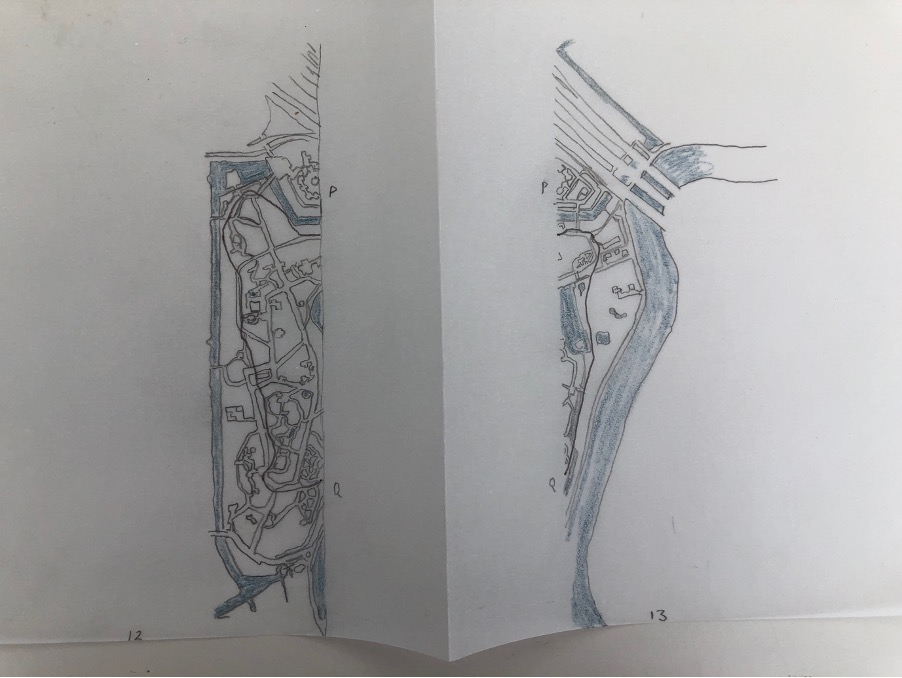
Eagerly looking forward to a room to yourself.
To do sómething.
To dó something.
To do somethíng.
Doing nothing is doing.
I have a key to a room in the city.
In a park, the Amstelpark. For a week (and some more) I can come and go, come and sit, come and do in this room. It is a room of glass. Outside it is light. Above my head, the light is filtered. The sliding windows open and close automatically. As if they also have something to say from time to time.
They open the room.
They close the room, a little bit.
The room is inherently open because of all the glass. Walls of glass.
A floor of stone. Outside mostly trees, plants, shrubs, inside some pots.
A ‘member’ cactus – Schlumbergera Cactaceae and four other plants in pots. One little tree has grown under the sliding glass door. Inside. Something with yellow flowers. We’ll look for that later.
A room in a park in Amsterdam.
A room whose key is in my pocket.
What to do with such a room. It is Monday. I brought some bags, some books, by bike.
A Room of One’s Own, My House, Home; philosophical explorations of the everyday, Tropisms, Architecture and Landscape; rational, formal, and pictorial staging and situational design, City Atlas of Amsterdam; city maps & street names explained. And also, some things to fill a room with or keep it empty or dress up or underline or align or measure. Taken a picture of an airplane. Heard a train. Traffic, cars. Heard.
Emphasize.
Looking outward.
Looking up.
Looking at trees.
Walk in the park and look up.
To the top of the park.
Not from above but from your eyes, as you stand, walk. Look up above past yourself like this, along the trunks.
A room of glass.
Among the trees in the park.
What defines this room.
The framing that keeps the glass in its rebates (keeps the tension in it) gives meaning to this room. A room full of rebates. Rebates and frames. The glass stretches, stretches and touches all sides of the light, between the front glass and the back glass. No. Behind the outside glass and in front of the inside glass. I look out through the glass from the inside. The glass is the wall. The glass captures every image that reflects. In this room of glass, everything becomes reflection.
The thing, the object, the mass is easily captured by the light taken away. Because the light does not pass through it but stops at the edge.
As with the body. The light stops at the edge of the body, and within it, darkness begins. No. The non-light. Although, more, I envision a pink twilight at the epithelial level. The “twilight” zone of the body.
If this chamber had a skin, the walls on the inside would be the epithelium, the “twilight” zone.
The outside of this room for oneself, or this room for one’s own, is like a body. That what goes on inside defines the room, no, in other words, the room of the self belongs to no one, or to the person who has the key, the access to the inside of this room. The room is an inside. Its outside is not necessarily visible. Its outside can be outside. An outside wall, outside but can just as easily be an inside of another kind of inside space.
The room is an inner space. This room of the self, as a starting point, may be an inner room, but once this room is entered, and the self, not the owner but the user, yourself, me, you, someone with a self, who has been given the key to enter this room and use it as a self, that person can call the room a self, more so, a room for your self.
This indoor room allows you your own time and space to think and look outside differently. Either with your full stature in front of an open exposed window, or with your stature hidden behind a blind wall and your gaze sliding through a crack. A crack to the world. A crack in public space, outer space, public space. A crack that gives away, betrays another space. A crack that reveals a glimpse of a space that is hiding. Which may be a bit too narrow to be very public. But still reveals itself through a small opening.
A crack, in other words.
A crack to the outside world.
A crack also to the inner world.
The crack as the phenomenon or concept that exists by grace of those two extremes.
Inside and outside.
A recognizable phenomenon.
A sign in space that reveals another space.
A crack as a promise of another side. (Another world).
Looking out from a crack into the world. Who or what is looking back.
…
Can a room of glass still harbor a crack.
To look at another side.
To look outside.
This room of glass does not need a crack, you would say. This room does look that way anyway from outside to inside to outside.
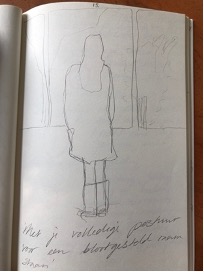
Space-related movements. Behavioural residuals. Movements of bodies inside and outside. It is a coming and going. Walking by. Walking away. Walking in. Walking outside. Walking forward. Walking backwards. Directions. I wrote down somewhere: True Navigation. The true, real direction(s). From the moment we move our bodies from standstill, there is navigation. Like a vehicle sets course, our body is our vehicle, setting course daily. Inside and outside.
Directions: Up, down, left, right, forward, backward, weight shifts
Displacements: straight, round, curved, angular, swaying, curving
Physical capabilities: collapsing, unfolding, bending, buckling, reducing, enlarging, reaching, stretching, shaking, vibrating, swinging, tolling, contracting, narrowing, expanding, lengthening, spinning, jumping, balancing, falling…
Space-related displacements: closer, farther, at the bottom, on top, against something; leaning, scraping, rubbing, pushing, pulling, rolling, springing….
Space related standing still: Positioning and standing still, closer, further away, at the bottom, on top, against something
Not moving
Almost not moving
Being
This following: The Movement Alphabet–The Verb. 2006 Ana Hutchinson Guest[1]
[1] https://www.lodc.org/about-us/what-is-language-of-dance/the-movement-alphabet.html (Accessed: 31 August 2021)
Sitting is positioning.
Writing is moving.
The legs folded under the chair.
The neck/back curves and stretches, repositions itself.
Let the neck be free for the back to lengthen and widen and
the head to go forward and up[1]
[1] https://connectingupthedots.com/2014/03/20/understanding-the-primary-directions-which-way-is-up/
(Accessed: 22 September 2021)
Visitors. Passers-by.
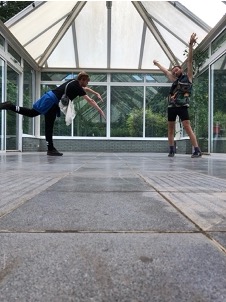
Passersby a. & b. Daniel & Danny from Amsterdam South-East. They are looking for a place to record a clip with their band ‘Cold in Church’. I ask them inside. I take a picture of them somewhere in the greenhouse.
In a place where normally in winter the plants are. By their “posing” for the camera (low-profile: my phone), an image is created, of a figure, a body, a different body than the plant-body now standing outside in a tub. Daniel and Danny pose with their bodies turned and their arms outstretched. They are not imitating plants but the space they are in makes them remind me of plants. The plants outside, which are in the orangery garden in summer, look in through the window glass and stare at these passers-by in plant poses.
 MARIKENOVERDIJK