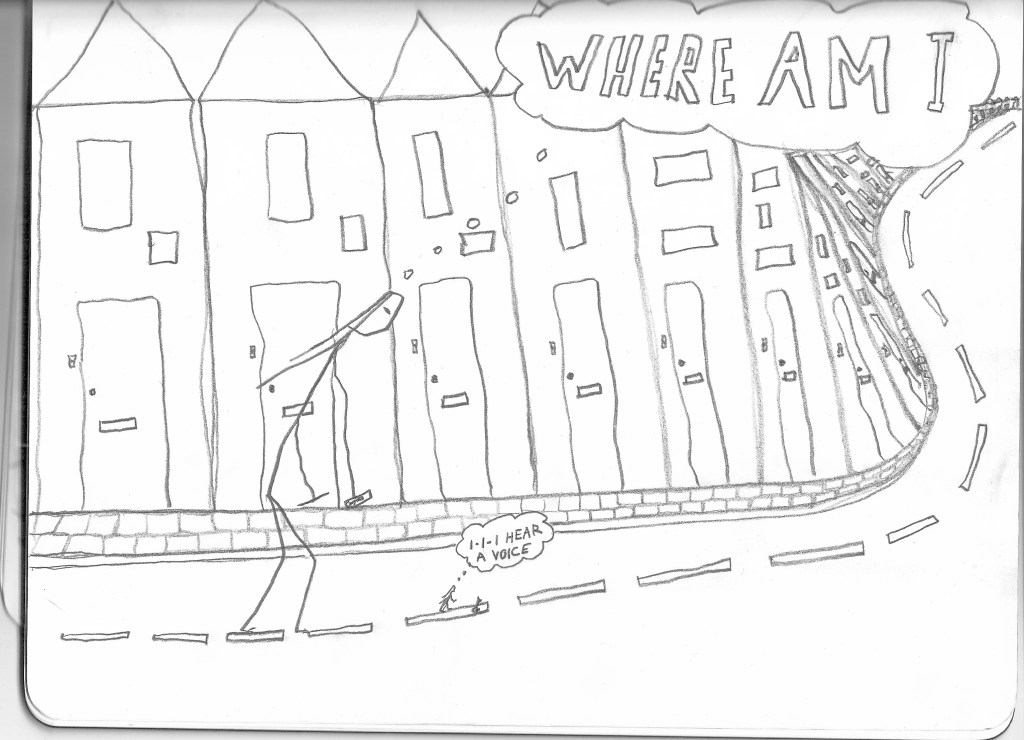
I relate my research to this psychogeographical aspect on how the behaviour of individuals is affected by the surrounding by modes of drifting through my hometown of Amsterdam. How do different places in this urban-scape make us feel and behave? The relationship between the town and its inhabitants is at the core of my research and connected to the dérive [literally: “drifting”], a technique of rapid passage through varied ambiances.
In his Theory of the Dérive (1958), Guy Debord refers to a study by Chombart de Lauwe, Paris et l’agglomération parisienne (1952) in which de Lauwe “diagrams all the movements made in the space of one year by a student living in the 16th Arrondissement. Her itinerary forms a small triangle with no significant deviations, the three apexes of which are the School of Political Sciences, her residence and that of her piano teacher” (Debord, 1956/1958).
Debord approaches the dérive as a way to become aware of this habitual axe, the daily passing. He is signaling the opportunity to dérive within the architecture of the city. By being out on the street without an economic or social purpose, this drifting may come across as an unproductive motion.
Specifically, in this idle area I can see that there is something to be gained like a poetic act of relating to the daily contemporary environment and an opportunity to gain knowledge about what a daily walk through the street can tell us. About a potential layer of meaning in the street. My own practice is precisely touching upon this way of drifting: from the street into someone’s house and out again.
The daily wandering through my own neighbourhood makes me experience the city as an existential part of my home. And I see that the city floor runs through all the houses.
 MARIKENOVERDIJK